The Boeing 747: Bringing the World Closer to Greece

Few aircraft have left a mark on commercial aviation quite like the Boeing 747. Instantly recognisable by its distinctive upper deck, the “Queen of the Skies” transformed long-haul travel and became a symbol of a new era in global aviation.

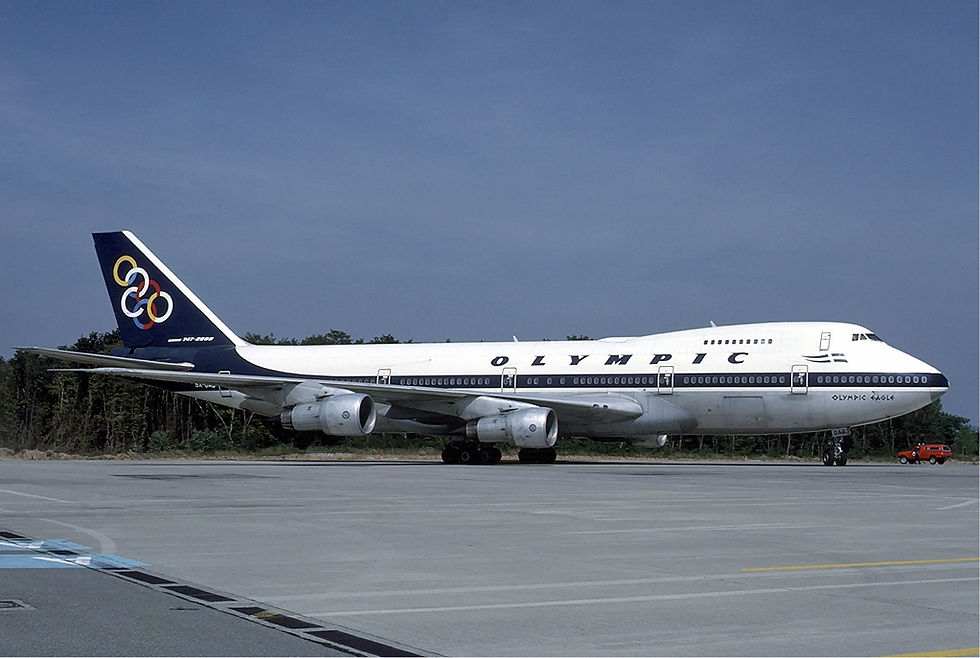
For Greece, however, the Boeing 747 represented much more than technological progress. When Olympic Airways introduced the Jumbo Jet in 1973, it marked one of the most significant moments in the country’s aviation history. The aircraft strengthened Greece’s connections with the world, brought distant destinations within easier reach and reinforced Olympic Airways’ reputation as one of Europe’s leading international airlines.
A Vision Beyond the Horizon
During the late 1960s, the aviation industry was changing rapidly. Airlines were preparing to introduce a revolutionary aircraft capable of carrying hundreds of passengers across oceans while offering unprecedented comfort and efficiency. The Boeing 747 promised to reshape international travel, and Aristotle Onassis knew Olympic Airways could not afford to be left behind.
Having already established Olympic Airways as a respected international carrier, Onassis wanted the airline to compete alongside the world’s leading names. Introducing the Jumbo Jet would demonstrate that Greece was ready to embrace the future of commercial aviation.
Olympic Airways ordered two brand-new Boeing 747-284B aircraft, registered as SX-OAA and SX-OAB. They were named Olympic Zeus and Olympic Eagle, becoming the airline’s largest and most prestigious aircraft and symbols of a bold new chapter in Greek aviation.
A New Chapter for Greece
On 21 June 1973, the first Boeing 747 touched down at Athens’ Ellinikon Airport. For many Greeks, it was their first opportunity to see the world’s largest passenger aircraft up close. Its immense size, four powerful engines and distinctive upper deck left an unforgettable impression.

The Jumbo Jet entered service almost immediately, transforming Olympic Airways’ long-haul operations. Services between Athens and New York entered a new era, while the aircraft later supported routes connecting Greece with Canada and Australia, serving some of the world’s largest Greek diaspora communities. For thousands of families separated by continents, travelling home became easier and more accessible than ever before.
Beyond carrying more passengers, the Boeing 747 also played an important role in supporting Greece’s growing tourism industry. By increasing capacity on international routes, it helped welcome more visitors to the country during a period when overseas travel was becoming increasingly popular.
More Than Just an Aircraft
The Boeing 747 quickly became the flagship of Olympic Airways. Passengers admired its spacious cabin, the iconic spiral staircase leading to the upper deck and the prestige of flying aboard what was widely regarded as the world’s most advanced passenger aircraft.
At a time when air travel still carried a sense of glamour, boarding an Olympic Airways Jumbo Jet became an experience many travellers never forgot. Whether flying for business, returning home to visit family or beginning a holiday in Greece, the aircraft represented progress, opportunity and national pride.
For Olympic Airways, the Jumbo Jet was far more than a new addition to the fleet. It reflected the airline’s ambition to stand alongside the world’s leading carriers and showcased Greece’s growing confidence on the international aviation stage.
A Legacy That Lives On
Although the era of the Boeing 747 has largely come to an end, its legacy remains deeply woven into Greek aviation history.
One of Olympic Airways’ original Jumbo Jets, Olympic Eagle (SX-OAB), has been preserved at the former Ellinikon Airport, serving as a lasting reminder of the airline’s golden age and Aristotle Onassis’ ambitious vision.

More than fifty years after its arrival, the Boeing 747 continues to symbolise an era when Greece looked confidently towards the future. It brought families closer together, strengthened ties with the Greek diaspora, supported tourism and helped establish Olympic Airways as one of the most recognisable airlines of its time. Few aircraft have left such a lasting legacy on Greek aviation—or such enduring memories for those fortunate enough to fly aboard the Queen of the Skies.
Sources
Olympia.gr – The History of Olympic Airways’ Five Jumbo Jets
https://www.olympia.gr/574817/ellada/liga-logia-gia-tin-istoria-ton-pente-jumbo-t/
The Ellinikon – A Trip Through Time, from Prehistory to the Present
Olympic Airways Aircraft Fleet – Technical Operations Department
https://www.airliners.gr/extras/AGV/OA_Histo_Fleet.pdf


Comments